Posts

Showing posts with the label SOA

SOA Reference Architecture : Service Component Layer (IV)

Image
The Service Component Layer is partitioned into the following categories: Service Realisation and Implementation  Service Component : realises services Functional Component : provides business functionalities in the realisation of the Service Component . Technical Component : supports Functional Component.  Service Publication and Exposure Service Publisher : stores metadata about services in  Service Repository (Governance Layer) IDE : define and develop Service Components Service Deployment Service Deployment Manager : deploys Service Components to Services Container according to the Service Registry (Governance Layer) => automation. Service Invocation Service Invoker : invocation of the Service Components  from the Service Layer. Service Binding Service Implementation Binder : transforms request from Service or Integration Layer to the required in-bound call of the Service Component (e.g. WSDL) Method Input/Ou...

SOA Reference Architecture - Operational Systems Layer (III)

Image
This layer is responsible for the runtime and deployment infrastructure. Service Delivery Solution Component : provide functional capability of the services Implementation Controller (IC) : Delegates request to the appropriate Solution Component. Incorporates (de-)composition of legacy systems into Solution Component . Integration Layer   | Integration Controller  : coordination and brokering interactions between ABBs. Application (Packaged and Custom)  Legacy Systems DB Quality of Service Layer : Policy Enforcer, Access Controller Runtime Environment Runtime Hosting Environment (RHE) :   support for operational and runtime services Solution Platform : JVMs, CICS environment... Solution Building Block : runtime component of ABBs from other layers Deployment Unit : executable application (exe, war, ear...) Virtualisation and Infrastructure Services Hardware Virtualised infrastructure : use of shared disk space in a cloud environment Quali...

SOA Reference Architecture : Description of Layers (II)

Image
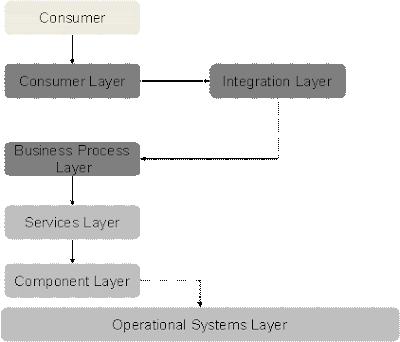
Each layer of an SOA may be described this way : Overview Capabilities supported Logical aspect (structural elements) Interaction (ABBs within/across layers) The image below depicts a typical interactions among the layers :

SOA Reference Architecture : Introduction (I)

Image
In this new series of articles, I'll present briefly the Service Oriented Architecture (SOA) concept. You can find useful information on the SOA Reference Architecture . The benefits of using an SOA approach are mainly: Reducing cost Agility Increase competitive advantage Faster time to market Consolidation of systems Better align IT to business goals The SOA Reference Architecture (SOA RA) provides an abstraction for SOA-based solutions. The SOA RA gives us an abstraction using common layers: Cross-cutting (vertical) Layers: Integration Layer : mediation / routing / protocol transformation Quality of Service Layer : manage Non Functional Requirements (NFRs) Information Layer : data needed for horizontal layer creation Governance Layer : Manage policies and business rules (registries / repositories) Functional (horizontal) Layers Operational Systems Layer : runtime environments for all layers Service Component Layer : services implementatio...